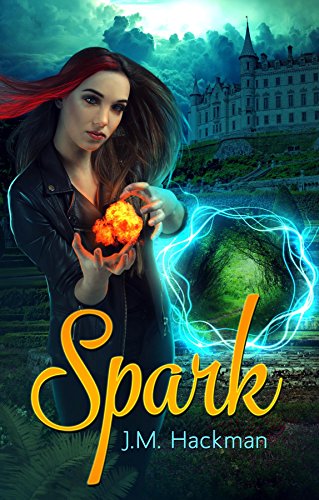
Spark by J.M. Hackman, book one of The Firebrand Chronicles
Summary
Brenna James wants three things for her sixteenth birthday: to find her history notes before the test, to have her mother return from her business trip, and to stop creating fire with her bare hands.
Yeah, that’s so not happening. Unfortunately.
When Brenna learns her mother is missing in an alternate reality called Linneah, she travels through a portal to find her. Against her will. Who knew portals even existed? But Brenna’s arrival in Linneah begins the fulfillment of an ancient prophecy, including a royal murder and the theft of Linneah’s most powerful relic: the Sacred Veil.
Hold up. Can everything just slow down for a sec?
Unwilling yet left with no other choice, Brenna and her new friend Baldwin (Um, hello, Hottie!) pursue the thief into the dangerous woods of Silvastamen and beyond. Exactly what Brenna wanted to do for her sixteenth birthday. Exactly. When they spy an army marching toward Linneah, Brenna is horrified. Can she find the veil, save her mother, and warn Linneah in time?
And more importantly, why on earth doesn’t this alternity have Belgian waffles?
Review
(Spoilers ahead)
1. Plot
Brenna’s entrance to Linneah is a strong beginning. Magical powers and alternate realities are introduced almost immediately, along with Brenna’s goal to reunite with her mother and a hint of conflict in the form of monsters. Discovering her Firebrand talent is a good hook, too. From the beginning on, the readers are introduced to a new world without interrupting the plot’s smooth flow, which isn’t an easy feat.
Most of the plot twists are well foreshadowed. The existence of Merripens (shapeshifters) is established long before Brenna meets Anna. Tiny having magical heritage explains why she reacts so calmly to Brenna’s Firebrand talent in the first chapter. The only plot twist that comes out of nowhere is the one with the biggest impact on the plot: Talus being Brenna’s half-brother. A good twist has foreshadowing planted into the story before its reveal. There are no clues or hints that ever suggest Brenna having a secret half-brother, which leaves the twist feeling random and forced.
2. Character
The antagonists are by far the weakest part of the book. First, there’s Rune, the person who captures Brenna’s mother. He has a reputation for sadistically torturing his enemies, but it never actually affects the plot. In fact, he doesn’t actually appear in the book at all. He’s presented as a mysterious figure working from behind the scenes. And that would be fine if another villain was interesting in his place, but instead there’s Talus. His goal is to persuade Brenna to ally with his master, Rune. When she refuses, he declares her expendable. The problem is that he poisoned her before her refusal. If he initially wanted her alive, why did he try to kill her? Talus’ plan doesn’t make sense, which makes it hard to see him as a genuine threat.
Brenna is our protagonist. My favorite scene is immediately after she kills someone. Even though the person she killed was a “villain,” she regrets what she’s done and wrestles with her morality. It’s a reaction that feels real. Then the climax happens. Brenna kills enemy warriors without hesitation and feels no remorse afterward. With some buildup, this could work, but to me it’s just jarring. It also makes the earlier scene ring hollow. After all, her guilt can’t matter that much if she moves on so quickly.
3. Worldbuilding
The worldbuilding has some good concepts, but is inconsistent and ultimately feels like a missed opportunity. Linneah has been at peace for centuries, but for some reason has a fully trained military anyway. The absence of an army wouldn’t just up the stakes but also set Linneah apart from many other fantasy societies.
Another inconsistency is the issue of language. Personally I don’t consider it a requirement for a fantasy novel to have its own original language. However, the book itself states multiple times that the character Talus has to join Brenna’s quest because he speaks other languages: “But because of my travels, I am fluent in many languages…Did you know there are several dozen dialects in the Northern Province alone?” Then they travel and never encounter any other languages. Nothing ever needs translation.
Like The Chronicles of Narnia, Spark is a faith-centric fantasy. Again, there’s potential here since most fantasy novels treat religion as an afterthought. The only problem is that the religion is overly simplistic. There’s no mention of other religions, nonbelievers, or even different ways to worship. Everyone in Linneah worships by going to buildings with stained-glass windows.
Recommendation
I didn’t hate this book, but I didn’t love it either. Spark has a lot of potential. While it has some touching scenes, engaging character voice, and the glimpse of an intriguing world, it also has inconsistencies and weak antagonists. Fans of fantasy and YA may enjoy it.

 Luna Swift